Tuesday, January 1, 2008

Balaclavas

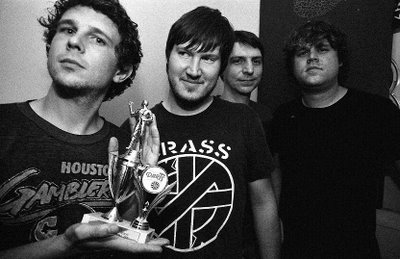
Photograph by John Van

Balaclavas’ newest album shows a band that understands the narcotic that is atmosphere. “Inferno”, the title track, is drenched in a mist of swirling guitars, drones, and textures that ride alongside the incessant march of Charles Patranella’s drums and the pounding of the bass of Brian Harrison. Tyler Morris’ vocals cry out with a combination of fear and defiance as the band takes Dante Alighieri’s fevered dream opening of L’Inferno and spits their own blood back out. This is not a band that is content with merely signing a song but one that wants to push your idea of what a rock band should be on record, on stage, and as a creative endeavor.

When I first heard of Balaclavas the same adjective kept popping up – weird. Tyler’s quite familiar with that analysis, “People assume we’re being weird or dark for its own sake but, for us, it isn’t weird or dark – it’s jovial and satirical. Like in our album we poke fun at apocalyptic world views. Sure that may happen - but not right now. All that does is instill fear.”

Brian laughs, “We take those views and stick a thumb in that eye.”

Charles also can’t understand why people find them so odd, “When we write songs, nothing is brought in beforehand - we’ll improvise then take it and form a structure around it. People keep telling us we need to get inside this box…this world…but our music isn’t forced. When it is forced, it’s total shit and we drop it.”

For Brian improvisation is critical to any band; “There’s a point in every show where we don’t play it how we practiced. That’s how you know you have a connection with your band - when you can go off and they can follow.”

A band should be about taking risks says Charles, “When something doesn’t fuck up, you’ve fucked up. There are so many bands that are polished. Those bands are about the middle ground. I can’t stand the middle ground! The worst you can do is not get a reaction.”

“When I’m on stage,” explains Brian, “I don’t want to break the audience’s focus. I want there not to be apathy. It’s like a conversation – when you are talking someone has to listen.” Asked why not just stay home and listen to a record he replies, “Live music is immediate and of the moment but there is also a social aspect to it that’s important. People just don’t get out together aside from live shows and maybe sports.”

Tyler agrees that the social aspect is crucial, “I want the audience and the band to be whole. When I go to live shows I don’t see people communicating. What I see is a lot of nihilism. Fuck that! I want there to be a conversation! People have been consumed by culture to the point where they have nothing to say.”

Brian jumps in, “You can boil down American culture to two things: celebrity and over-consumption. Celebrity discounts normal life and over-consumption can’t last forever.” His point is that people shouldn’t be mindlessly consuming but making things, “You don’t have to be special to make a CD. It’s easy. If people understood how easy this is, there wouldn’t be this distance and when everyone produces media then it becomes democratic.” I suggest that with everyone making music there is a lot more clutter and that, to a large degree, digital downloads take away the fun of digging up an LP at the local record store but Brian chides me, “Don’t be overly nostalgic. Now, instead of kids trying to dig up albums, kids are making albums.”

Tyler elaborates on the value of creating, “I get into a trance. It’s like a shaman conjuring up sounds. It’s intellectually stimulating and entertainment is important - entertainment that lasts in your brain and that makes you think.”

“The thing is”, says Brian, “art and creativity is play but on a different level than a child - it’s adult play. It’s fun to communicate. With [corporate] mass media you are being talked down to and there is no communication; I sure don’t have anything in common with some executive in L.A., but at the grass roots level, you’re communicating with the audience and there is more sharing especially when it’s something handcrafted and DIY. The dollars are taken out and it’s all blood sweat and tears. ”

That is the thing that anyone who hears Balaclavas immediately understands- the making of music and how it is something that can be expressive, joyous, challenging, and inspiring. Balaclavas is a challenge to not approach music and life as it is given but to go out and find your own voice as they have or as Tyler puts it emphatically “Make something!”


Balaclavas will be re-releasing their extremely limited edition CDs (Inferno and the earlier eponymous Balaclavas) on vinyl on Phonographic Arts/Compound Records in 2008.

Balaclavas on Myspace (Link)

Friday, December 7, 2007

Imagine VS Let it Be


A comparative analysis of their philosophical differences
By Omar Afra
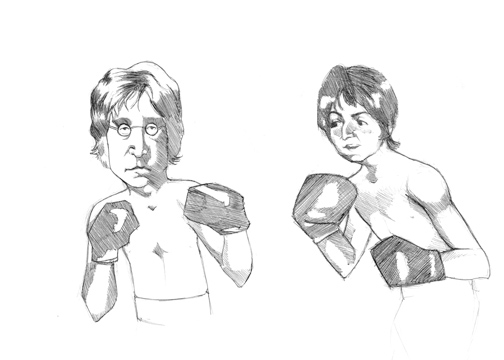
Illustrations by Shelby Hohl


Alas, the never-ending battle between ideologues and utilitarianism pervades every bit of our world. Do we strive for an unattainable utopia or should we let go and find a happy ‘complacence’ in our dark world? Perhaps these are over simplified, out-moded strains of thought but the question remains: Can we achieve a perfect world or do we just make a happy collective sigh and say ‘fuck it’. Well, in my silly head, Lennon and McCartney were discussing these polemics in Let it be and Imagine. The dichotomy of their thinking is not only indicative of their ideological differences but their personal turmoil as well.

The two songs were written just a year apart during and after the tumultuous break-up of the Beatles that was preceded by the conflicted Get Back/Let it Be sessions. Let it Be, written during these sessions in 1970, and Imagine, written on Lennon first solo album in 1971, could easily be interpreted as a dialogue between the two on their diametrically opposing worldviews.

Imagine is a treatise of optimism for a quixotic, illusory world void of war, famine, religious strife, and probably void of McCartney as well. Lennon personally described the song as “virtually the Communist Manifesto.” The song is ardently anti-religious, anti-capitalist, anti-nationalistic, and have course, anti-McCartney. It is very easily interpreted as an extension of Plato’s Republic where the beauties of society reign supreme and there are perfect social, political, and spiritual orders. . Nonetheless, others would argue that the song does not advocate an ‘answer’ or ‘solution’ yet merely encourages the listener to ‘imagine’ these things.
Critics of the song characterize it as nothing more than the grandiose ramblings of an insulated rock star that was sitting on nearly 100 million dollars. English journalist Robert Elms said "Imagine" was written by a "multi-millionaire with one temperature-controlled room in his Manhattan mansion just to store his fur coats." Deluded or not, Imagine has had an enormous influence and impact on modern culture that reaches beyond shitty classic rock radio. President Jimmy Carter once joked that the song is played about equally with national anthems around the world

Let it Be has had a profound cultural impact but in a very different way. Many Catholic’s have adopted the song as an anthem based on a misinterpretation of the intro lyrics “ When I find myself in times of trouble, Mother Mary comes to me.” The reference is not an ode to the Christ’s Mother but rather to McCartney’s mother who died of cancer when he was 14 years old. Stress over infighting among the Beatle’s during album sessions, McCartney had a dream where his mother visited and told him “It will be alright, just let it be.” Nonetheless, there is no denying the theistic elements of the song. Let it Be pictures a flawed world where we exercise little control other than to find acceptance and resignation. We are told “there will be answer” yet are not told what that answer may be. Just wait. It will fall from the sky. Oddly enough, the English translation to the word ‘Amen’ is ‘let it be.’ Paul bemoans that “When all the broken hearted people living in the world agree, there will be an answer.” Does this mean that the ‘answer’ manifest itself once and for all upon the moment of all ‘broken hearted people’ finding some kind of consensus. This, however, leaves me ultimately with more questions than answers. Let it Be also does a surreptitious job of capturing the spirit of The Serenity Prayer where one is encouraged to ask the Lord to “Grant me the serenity to accept the things I cannot change, the courage to change the things I can, and the wisdom to know the difference. “ However, Let it Be relies heavily on not only Judeo Christian thought but has Buddhist tendencies as well. The song espouses detachment just as many Buddhist and Hindu doctrines prescribe release from worldly desires and expectations. Critics would call this viewpoint apathetic or even dissassociative, Lennon was not a fan of Let it Be either. He once said that McCartney was “ just trying to re-write Bridge over Troubled Waters” and that Wings as should have recorded the song opposed to the Beatles. Harsh words indeed.

Ultimately, Lennon and McCartney present strong cases for their particular world-views. Lennon typifies an idealistic yet naïve hope for a world that lacks the presence of all the stratifying differences that cause us so much strife and turmoil. We can no doubt ‘imagine’ such a place but must conscious of what are immoveable forces in our universe. Personally, I more readily subscribe to the McCartney-esque detachment put forth in Let it Be but hope the world fills up with more Imagine sympathizers. There are just way too many jaded pragmatists like myself.

Editors Note: Dating and chronology are open to dispute as journalists and Beatle’s themselves rarely share consensus of what is factual and what is merely mental residue from LSD.

Saturday, December 1, 2007

Hearts of Animals

Photography: Theresa K. © 2007

It’s a bright Saturday afternoon in the Montrose. The Westheimer block party has just begun and the larger crowds that will eventually pack the area have yet to arrive. As you step into Numbers, the darkness envelops you until your eyes adjust. On stage is a woman behind a microphone holding a guitar; a Macbook sits atop a folding chair to her right. She reaches down - punches a key. A drum machine echoes though the cavernous room. She begins picking notes on the guitar and she sings. The songs she sings evoke a loneliness and weariness earned through experience: bright poppy melodies that ring of hope and beauty with an undercurrent of sadness. If pop music is intended to be trite and disposable, in the hands of Mlee Suprean’s Hearts of Animals pop becomes something more – through her lyrics, sense of melody, and rich textures – it becomes literary.

You could argue that music is in her blood. Her father’s a talented bass player whose hook-filled work graces a few Hearts of Animals tracks. Her mother’s side of the family were talented West Virginian folk musicians and the family still retains old scratchy records of family members performing Appalachian songs. Mlee retains that organic approach to music. She graduated with a music degree (half of a double major) from HBU yet, to her professor’s frustration, she resisted music theory; “It was like re-wiring my brain. I play by ear, so it was very difficult learning and applying the math of music. I let my emotions write my music instead of trying to force my technical learning into my songwriting.” Her latest EP is a perfect example of her writing from her gut. “I was going through a separation, I was ready to move on, and I’d never acted on that before.” It had been a year since she had written anything then “one night that summer I sat on the balcony and wrote three songs.” She later followed up this spark with four more songs that appeared on the Hearts of Animals debut EP Lemming Baby. It’s an EP rich in emotion and immediacy. Stars Say No, for example, deals with the realization that the one you are with may not be the right person. The song plays on a Big Audio Dynamite song; in response to Mick Jones’ Mr. Walker saying, “We’re heaven made”, Mlee’s Mr. Walker concedes that the astrology is all wrong. Twenty Questions’ bouncy bass line and sweet melody are belied by the nastiness of being confronted by a lover’s suspicions. It’s all pretty heavy stuff for a pop song but not all of her debut is all dramatic soul searching. Take Underwater Staggie’s psychedelic pop which puts you next to Mlee as her friend Stagner discusses 2012, giants, astrology, and Houston’s eventual submersion into the Gulf of Mexico. The songs lyrical content is playful, the melody is gorgeous, and the attention to texture, instrumentation, and arrangement is nothing short of masterful.

Hearts of Animals’ current incarnation was something Mlee arrived at through an evolutionary process. The project became a personal challenge to prove to herself that she could indeed hold an audience’s attention, “By nature, I’m antsy. If I get bored with a band, I leave. Last summer I was playing at coffee houses then, I threw-out beats and people freaked out.” Beats and volume are hardly a coffee house staple but she followed her instincts and audiences loved it - volume and all. The physicality of volume is something Mlee relishes, “With a show, I want ears to hurt a little bit otherwise I’d be at home listening to the record.” The use of prerecorded tracks came a bit later as she initially felt it would be “cheesy” but after some prompting she gave it a go and, again, the risk paid off.

Beyond the rich melodies, textures, and performance, what holds audience's attention is Mlee’s ability to write songs that are universal and yet very personal. The songs are not mere melodrama but are honest and conflicted internal dialogues where the narrator remains unsure and hesitant because, in life, choices have consequences. Mlee then takes that tension between fear and hope within the songs and grounds them in a particular sense of place – take the recurring seaside motifs for example. These sprinkled settings create a very real and tactile world yet there is a haze between what is literal and what is metaphorical and between what is said and what is unsaid. “I think there is a skill in expressing something without saying it. I like a story with lots of color, where I give them a window, but where people are left wanting more. I don’t want people settled; I want them engaged and intrigued. It’s like the end of Lost in Translation. What does he say?”


Hearts of Animals performs at the final night of The Texas
Gone Garage festival on Sunday December 16th at Rudyard’s. For more
information see http://rudyards.s425.sureserver.com/TGG/.


====Additional Web Links and Information===


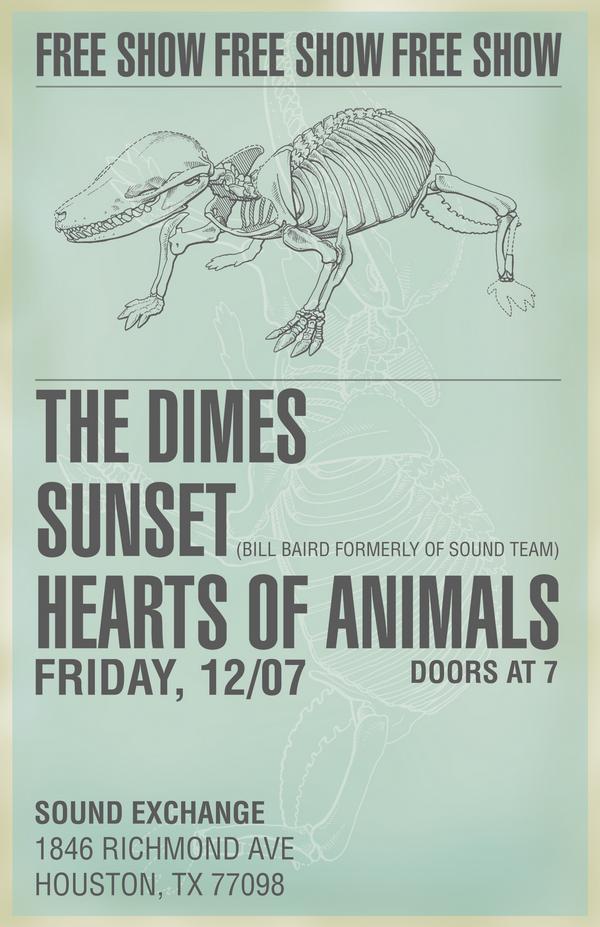
Hearts of Animals plays with the Dimes and Sunset at Sound
Exchange on Friday 07 December 2007 (Poster)


Also, there is a nice Houstonist article on Hearts of
Animals that was juts posted today that is a nice compliment
to this article.


MleeMarie on Myspace

Monday, November 12, 2007

Homegrown Reviews


HISD (Hueston Independent Spit District)
The District

This debut album by the crew of 8 local emcees and producers is a diamond in the rough that effectively dodges H-Town hip-hop clichés while maintaining a solid southern flair. This 19-track project is a versatile blend of clever lyricism and soulful production rife with strong word play, local references, and reverb drenched beats. HISD is comprised of a veritable who’s who list of greats including Soul One, Flash, Scottie Spitten, King Midas, E Classic, Savvi, and my favorite- Equality. Equality has been performing his spoken word/emcee hybrid the H-Town circuit for years at festivals, protests, and concerts alike. Subject matter deftly jumps between issues like ingrained local racism to staking girls at the Galleria. Bright spots: Paper Bag Rap, 3 Story House, and The City.

myspace.com/hisd

Thursday, November 1, 2007

Bring Back The Guns

Photography: Rosa Guerrero
It's a Monday night at Francisco's on the east end of downtown. Inside Bring Back the Guns are rehearsing as a German cockroach overlooks the proceedings from an electrical conduit over the door. It's a week before their record release at Numbers for the new album Dry Futures on Feow Records and guitarist, singer, and principal songwriter Matt Brownlie is busy playing conductor with some new material he's written. As Matt and the band bounce ideas, drummer Thomas Clemmons sneaks potato chips from a bag between runs, bassist Ryan Hull fiddles with his ubiquitous baseball cap, and a yawning Erik Bogle tries to extract some insect from a guitar pedal only to crush it inside for all his effort. It's a pretty brutal process and my notes read as such; "8:15 same riff. 8:23 same fucking riff 8:35 Oh god just kill me they are still at it." Then something happens a bit over an hour from when they started and around the same time that I start thinking of a way to politely excuse myself – the pieces falls together, the song works, and it's incredible. Suddenly the room is alive and even the formerly fatigued Erik Bogle is grinning ear to ear. It's a perfect example of what people never see when they go see a show or buy an album. To a fan, it's as if the previous hour of work didn't happen but the fact of the matter is this painstaking chiseling of marble happens all the time in music.

Bring Back the Guns know all about chiseling; it's taken three and a half years to release Dry Futures - one year to record and another two and a half in the dubious limbo of record label shopping. You'd think after such a long incubation period, not to mention a decade long career, they'd be tired and dreading an upcoming tour yet, when we meet at Rudyard's, Ryan is actually excited. "As much as we've done it, I never have a bad time on the road. At times on the road, yeah, it gets rough but then I think, here I am with my friends on the road having a good time…I'm not at work. Oh wait, this rules!"

Erik expands on the typical band hardships, "You deal with the crap because there's no other option. You deal with it because the music is worth doing. It all starts as a 20 year-old's dream of being a rock star…"

Matt interrupts, "The idea of a rock star was more plausible when we started than it is in 2007. The game's changed so much. When we started-off, a weird and singular band like the Pixies could get national exposure but now the national scene is so flooded that the playing field has leveled."

"Well,' says Thomas, "I don't think we knew what we were doing back then. We had a five year learning curve."

"If I could go back," says Erik as he sips on a beer, "I would tell myself to do two things - tour and hire a publicist. If you are gonna be a band that sits in the armpit of America you need someone who knows what they're doing."

Matt sighs, "It's unfortunate that any band worth its salt has to buy publicity – it's a goddamn shame. You'd hope that a band making awesome music wouldn't need to but if a tree falls in the forest…"

"…if a band plays in Houston!" exclaims Ryan to great laughter.

Erik elucidates, "Any band working through a real label has PR. A label not only has to facilitate production and distribution but also has to coordinate with people to get them heard above the fray." All right fine, but what about the punk rock kid who says having a publicist ain't DIY or punk?

Brownlie responds, “First, we are doing it ourselves it’s our money being put into this album. Secondly, [in response to why a band needs a publicist these days] years ago there were like 50 touring bands touring the country…hell, I know 50 Houston bands alone.”

Meanwhile, Erik isn't standing for any claims of punk purity, "Hey, the Sex Pistols were a put together boy-band assembled to make money from dissent."

So if you are doing it for yourself, why not just stay in the garage and what do you want from listeners? Erik expounds, "It's just natural…if you love something you want to share it. The reaction I want from people is the reaction you get when you listen to an album and you can't let it go or the reaction of that guy sitting at the bar, turning his head slowly, and saying 'Wow!' Some of my most exciting times of my life have been attending concerts. Get drunk with me and I'll tell you all about it!" As Erik says this, I sense Charles Bukowski nodding and nothing more needs to be said on the matter.